

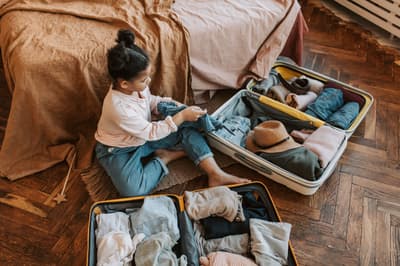

The Perfect Travel First Aid Kit: A Checklist to Tick Off
From a fever thermometer to the certificate for narcotic medications: what belongs in your travel first aid kit, what to add for the tropics and for children, and how your medications get through heat and flights in good shape.
In short
Every travel first aid kit should contain enough of your personal medications, remedies for pain, fever and diarrhea, and dressing materials. For long-haul trips, add mosquito protection and, depending on your destination, other remedies after medical advice [1][2]. Important medications go in your carry-on luggage, ideally in their original packaging and with the necessary documents [1].
Whether it is a city break or a long-haul trip: a well-packed travel first aid kit saves you a lot of stress if something happens. It is individual and depends on your destination and planned activities. So before every trip, check what you really need and compare the list with your medicine cabinet at home [1].
What belongs in a travel first aid kit?
The checklist is divided into three groups: the basic set for every trip, additions for long-haul trips and the tropics, and extras for families with children.
Travel first aid kit checklist
Basic set for every trip
- Personal medications in sufficient quantity plus a reserve for delays (availability and quality are not guaranteed everywhere [1])
- Pain and fever relievers (e.g., ibuprofen or paracetamol)
- Remedies for diarrhea plus electrolyte/rehydration powder (ORS)
- Remedies for nausea and motion sickness
- Wound care: bandages, sterile gauze pads, disinfectant
- Sunscreen with a high sun protection factor (SPF) and after-sun lotion
- Fever thermometer, tweezers, scissors, disposable gloves
- Documents: Impfpass (vaccination record), Allergiepass (allergy ID), medication plan, plus copies of your doctor's letter and prescriptions, translated if needed [1]
Additions for long-haul trips and the tropics
- Insect repellent for the skin, for use throughout the day [2]
- Treated, fine-mesh mosquito net if your accommodation has no air conditioning or insect screens [2]
- Light-colored clothing that covers the skin, treated with insecticide if needed [2]
- Remedies for insect bites and itching
- Water filter or water disinfection product if safe drinking water is not available [2]
- Depending on the region, malaria prophylaxis or emergency standby medication, only after medical advice [3]
For families with children
- Fever and pain relievers in a child-friendly form (syrup or suppositories); clarify the dosage in advance with your pediatric practice or pharmacy
- Electrolyte solution made specifically for children
- Age-appropriate mosquito protection: products with DEET or icaridin only from age 2, IR3535 from age 1; for younger children, use nets and clothing instead of repellent [4]
- Children's sunscreen (SPF 20 or higher), sun hat with neck protection [5]
- Familiar bandages and a small "comfort kit"
Which medications make sense for children and how to protect your family while traveling is covered in our article Long-haul travel with children.
How do you transport medications correctly?
Pack your medications so that you can reach them at any time and they get through heat and security checks in good shape. Before your flight, check whether your medications and medical devices are allowed on board and in your destination country, and keep them in their original packaging with the package insert whenever possible [1].
Carry-on luggage, medication plan and certificates
- Always put important medications in your carry-on luggage – suitcases can get lost.
- Bring an up-to-date medication plan listing the active ingredients. Copies of your prescriptions and your doctor's letter help at security checks and if you need to see a doctor locally; a translation into the local language can be useful [1].
- Narcotic medications within the Schengen Area: You may carry narcotic medications (Betäubungsmittel) prescribed by a doctor for up to 30 days. For this, you need a certificate under Article 75 of the Schengen Implementing Convention, filled out by your doctor and certified before the trip by the responsible state health authority. It is valid for a maximum of 30 days, and you need a separate one for each narcotic medication [6].
- Narcotic medications outside the Schengen Area: A multilingual medical certificate stating the active ingredient, single and daily dose, and length of the trip is recommended, also certified by the authorities. Some countries require an import permit or ban certain active ingredients; ask the embassy of your destination country [6].
Heat and cooling. Most medications should be stored between 15 and 25 degrees Celsius; the exact requirements are on the package or in the package insert [7]. When traveling, insulin and other medications that need refrigeration belong in a cooler bag or insulated box [7]. In a car, the glove compartment, dashboard and rear parcel shelf are the hottest spots; it is better to store medications under a seat or under the luggage in the trunk. A car parked in the sun can heat up to as much as 70 degrees Celsius [7]. Suppositories can melt in strong heat, and ointments and creams can separate. Do not use medications that have melted once, even if they become solid again [7].
Shelf life. Before every trip, check the expiration dates and replace expired or opened packs. If tablets feel rough after humid heat or capsules have swollen, correct release of the active ingredient is no longer guaranteed [7]. If in doubt, your pharmacy can help.
Frequently asked questions
Your regular medication for the entire trip plus a reserve for delays. For narcotic medications, the amount must be appropriate for the length of the trip [6].
Usually yes. But check in advance what is allowed on board and in your destination country, and keep the medications in their original packaging [1].
You need a certificate following the requirements of the BfArM (Federal Institute for Drugs and Medical Devices) for narcotic medications, for example certain strong pain relievers [6]. Your doctor or pharmacy can tell you whether your medication is one of them.
Whether you need malaria prophylaxis or emergency standby medication depends on your destination and must be clarified by a doctor [3].
Note: This checklist is general guidance. Which medications make sense for you, especially prescription medications, is best clarified individually with your doctor.
Sources
- Auswärtiges Amt: Reisemedizinische Vorsorge (Abschnitt Reiseapotheke). (accessed October 15, 2026)
- Robert Koch-Institut: Empfehlungen der STIKO und der DTG zu Reiseimpfungen, Kapitel 2 (Hygieneregeln, Arthropodenschutz). Epidemiologisches Bulletin 27/2026. (accessed October 15, 2026)
- Deutsche Gesellschaft für Tropenmedizin, Reisemedizin und Globale Gesundheit (DTG): Malariaempfehlungen. (accessed October 15, 2026)
- Bundesinstitut für Risikobewertung (BfR): Abwehr von Mücken, Zecken und Fliegen: Gibt es gesundheitliche Risiken bei der Verwendung von Repellentien? (accessed October 15, 2026)
- Bundeszentrale für gesundheitliche Aufklärung (BZgA), kindergesundheit-info.de: Ohne Wenn und Aber: Sonnenschutz für Kinder. (accessed October 15, 2026)
- Bundesinstitut für Arzneimittel und Medizinprodukte (BfArM): Reisen mit Betäubungsmitteln. (accessed October 15, 2026)
- Landesapothekerverband Baden-Württemberg: Aktuelle Hitzewellen: Auch auf Medikamente achten (Presseinformation, 14.07.2022). (accessed October 15, 2026)
Latest articles


Travel medicine
Healthy Travel – Tips for Your Travel First Aid Kit and Vaccinations
July 7, 2025 · 4 min read