

Long-Haul Travel with Children: What You Should Know
The age at which each travel vaccination is possible, which mosquito protection works for toddlers, and when a fever after the trip is an emergency: a health overview for families before a long-haul trip.
In short
Before a long-haul trip, children should first have all age-appropriate standard vaccinations recommended by the STIKO (Germany's Standing Committee on Vaccination); some of them can be given earlier before the trip [1]. Depending on the vaccine, travel vaccinations are only approved from a certain age, for example hepatitis A from age 1 and typhoid from age 2 [1]. While traveling, sun and mosquito protection as well as safe food and drink are what count. A fever after a trip to the tropics must be checked by a doctor right away [2].
Traveling far with children is an adventure, but it takes a little more preparation. Young children have a higher risk of infections and severe illness than older children, and children who grew up in Germany are not immune to many pathogens found in travel destinations [1]. With the right planning, many risks can be reduced considerably.
Which vaccinations do children need for a long-haul trip?
The basis is always the STIKO vaccination schedule: before any trip, children should have all age-appropriate standard vaccinations [1]. So check your child's Impfpass (vaccination record) in good time, ideally 6 to 8 weeks before departure. Some travel vaccinations require several appointments spaced weeks apart, and not all vaccines are approved for every age.
Bringing standard vaccinations forward. The STIKO specifies time windows for standard vaccinations. If a trip is coming up, it can make sense to vaccinate toward the beginning of that window [1]. When traveling to areas with many measles cases, the first measles-mumps-rubella vaccination is possible as an exception from 9 months of age [1]. Meningococcal vaccinations may also be recommended generously depending on the destination country [1].
Travel vaccinations by age. Which travel vaccinations are an option depends on the destination. The table shows from what age the most important vaccines are approved [1].
| Vaccination | Possible from | Note |
|---|---|---|
| Rabies | Birth | Generous indication for children, because they have more frequent contact with animals |
| Japanese encephalitis | 2 months | Children's dose up to under 3 years |
| Hepatitis A | 1 year | Children's vaccines with their own dosage |
| Yellow fever | 9 months (as an exception, 6 months) | Not permitted under 6 months; only if needed, depending on the destination country |
| Typhoid | 2 years (injection), 5 years (oral vaccine) | Generous indication for children |
| Dengue | 4 years | Only after a previous, laboratory-confirmed dengue infection |
| Chikungunya | 12 years | Only during an outbreak or a longer stay with risk |
For planning, a travel medicine consultation in which your child's vaccination record and the travel route are reviewed together is useful. Which vaccinations are recommended for Thailand, for example, is covered in our article Which vaccinations do I need for Thailand?.
How do you protect children from sun and mosquitoes?
Children's skin is much more sensitive than adults' skin, because its own UV protection only develops during the first years of life [3]. Shade and clothing protect best; repellents and sunscreen are a supplement.
Sun and heat. Babies should not be exposed to direct sun at all, and until preschool age, children are best kept out of blazing sun entirely [3]. Recommended are a hat with a brim and neck protection, airy clothing with long sleeves where possible, long pants and, at the seaside, sunglasses with a good UV filter [3]. Protect exposed skin with a children's sunscreen with SPF 20 or higher, applied thickly enough and reapplied after every swim [3]. In the strong midday sun between 11 a.m. and 3 p.m., children are better off not playing outside [3]. In hot weather, it is also especially important that your child drinks enough.
Mosquito protection. In many long-haul destinations, mosquitoes transmit diseases such as dengue or malaria. Light-colored clothing that covers the skin, a treated mosquito net over the bed and rooms with air conditioning or insect screens are the basis [1]. Especially for children, this protection against bites is also the top priority when it comes to malaria [2].
With repellents, age matters [4]:
- Under 1 year: no repellent on the skin; use mosquito nets instead, including on the stroller, and long clothing.
- From 1 year: products with the active ingredient IR3535 are a gentler option.
- From 2 years: products with DEET or icaridin are possible.
- For children under 12, parents apply the product, following the instructions for use and not on hands, wounds, sunburn or mucous membranes.
Also pay attention to the age information on the package.
How do you prevent diarrhea in children?
The most important prevention is hygiene when eating, drinking and washing hands [1]. The rule is "Cook it, boil it, peel it or forget it": cook food thoroughly, peel fruit yourself, avoid raw food and salads [1].
In many long-haul destinations, tap water should not be used for drinking or for brushing teeth; industrially bottled water is considered safe, and ice cubes of unknown origin are best avoided [1]. Thorough handwashing with soap, especially after using the toilet, after changing diapers and before eating, lowers the risk of infection [5].
If it happens anyway. Diarrhea makes children lose fluids and salts. For babies and toddlers, this can quickly become dangerous [5]. Breastfed babies continue to be breastfed on demand; older children should drink small amounts frequently [5]. That is why an electrolyte solution for children from the pharmacy belongs in every family travel first aid kit. Discuss in advance with your pediatric practice or pharmacy how to dose it and which other remedies are suitable for your child.
When to take your child to a doctor right away
Fever during or after a trip to the tropics: See a doctor right away and mention the trip. Malaria can appear weeks to months after your return; young children are particularly at risk [2].
With diarrhea, get medical help right away if [5]:
- your child does not want to drink,
- vomiting occurs together with fever and diarrhea,
- high fever or abdominal pain is added,
- the diarrhea is bloody,
- lips and tongue are dry or your child urinates less often than every 8 hours,
- the abdomen is very tense.
How do you prepare for the flight, time difference and travel first aid kit?
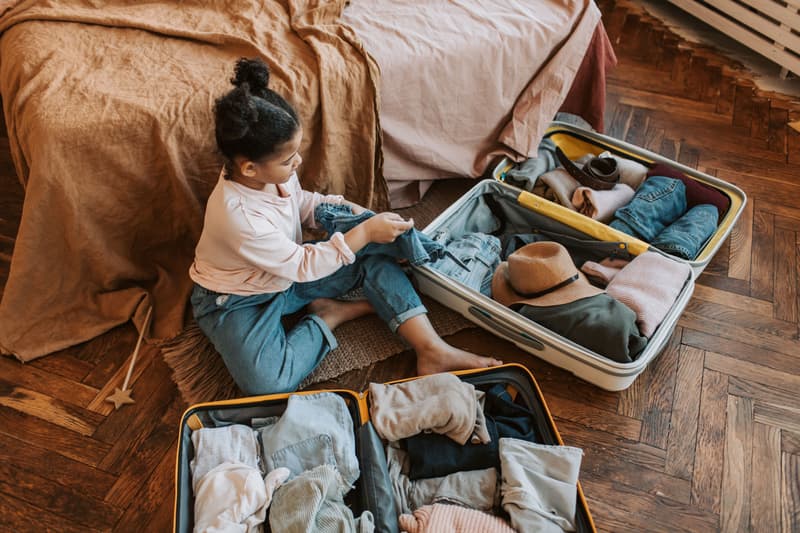
A long-haul trip usually starts with a long flight. During takeoff and landing, swallowing or sucking on a pacifier or bottle helps against pressure in the ears. Pack drinks, snacks, a change of clothes and the most important medications in your carry-on luggage so that you are covered even if there are delays.
Plan one or two quiet days after arrival so that the little ones can adjust to the climate and time zone.
Travel first aid kit for children. Children need their own dosage forms, such as fever and pain relievers as a syrup or suppositories, plus electrolyte solution, children's sunscreen and age-appropriate mosquito protection. Have your pediatric practice or pharmacy determine the dosage for your child's age and weight. A complete packing list with its own section for families can be found in our travel first aid kit checklist.
Frequently asked questions
Hepatitis A vaccines are approved from the age of 1 year [1].
Products with DEET or icaridin only from age 2, with IR3535 from age 1. For younger children, nets and clothing provide protection [4].
That depends on the destination and must be clarified by a doctor. For children, protection against mosquito bites is the top priority [2].
The STIKO recommends weighing the risks and benefits of a trip with the parents in advance, because infants and toddlers more often become seriously ill [1]. Get travel medicine advice early.
Ideally 6 to 8 weeks before departure, so there is enough time for vaccination series. These should be completed no later than 2 weeks before the start of the trip [1].
Note: This article does not replace individual travel medicine advice. Especially for children, vaccinations, medications and malaria prevention should always be coordinated with a doctor.
Sources
- Robert Koch-Institut: Empfehlungen der STIKO und der DTG zu Reiseimpfungen, Kapitel 2, 3.2 und 5. Epidemiologisches Bulletin 27/2026. (accessed October 15, 2026)
- Robert Koch-Institut: RKI-Ratgeber Malaria. (accessed October 15, 2026)
- Bundeszentrale für gesundheitliche Aufklärung (BZgA), kindergesundheit-info.de: Ohne Wenn und Aber: Sonnenschutz für Kinder. (accessed October 15, 2026)
- Bundesinstitut für Risikobewertung (BfR): Abwehr von Mücken, Zecken und Fliegen: Gibt es gesundheitliche Risiken bei der Verwendung von Repellentien? (accessed October 15, 2026)
- Bundeszentrale für gesundheitliche Aufklärung (BZgA), kindergesundheit-info.de: Durchfall bei Babys und Kleinkindern. (accessed October 15, 2026)
Latest articles


Travel medicine
Healthy Travel – Tips for Your Travel First Aid Kit and Vaccinations
July 7, 2025 · 4 min read